




Grass Running Short? How Controlled Bale Feeding Can Protect Winter Forage Stocks
August 31, 2026
Prolonged dry conditions and restricted grass growth are forcing livestock farmers in parts of Ireland to begin supplementary feeding earlier than expected.
For some farms, grazing supplies have become so limited that conserved forage intended for winter housing is already being opened. This can protect livestock performance and help maintain grazing covers, but it also puts additional pressure on winter feed stocks that may already be below target.
When every bale may be needed, the question is not simply how much forage is available. Farmers also need to consider how accurately it is being distributed and how much is being lost during feeding.
At Blaney Agri, we believe the answer is not simply to feed more silage. It is to maintain control over how much forage is fed, where it is placed and how easily livestock can access it.
Grass growth and winter fodder stocks under pressure
Recent PastureBase Ireland figures showed average grass growth across Ireland at 31kg DM/ha, compared with demand of 35kg DM/ha.
That national average disguised considerable regional variation. Growth fell as low as 8kg DM/ha in parts of the South-East, while some farms moved to full silage and concentrate diets because their grazing supplies had been exhausted.
The latest Teagasc Fodder Survey provides a wider indication of the challenge ahead:
- Only 42% of the dairy and drystock farms surveyed were on target or carrying surplus winter feed.
- A further 27% had deficits of less than 10%.
- Some 31% were at risk of more significant shortages.
The position was most severe in the South-East, where 40% of participating farms reported winter fodder deficits of more than 10%. Teagasc also recorded heavier supplementary feeding during July and August because of the lack of grass during the drought.
Completing a feed budget and identifying potential shortages early remain essential. Machinery cannot replace that planning, but the right feeding system can help farmers use the forage they have more accurately and avoid preventable losses.
Why controlled outdoor bale feeding matters
Placing a complete bale in a field may appear to be the quickest option, but it gives the farmer limited control over distribution.
Livestock can pull forage from the bale faster than they consume it. Silage may then be walked into the ground, contaminated with soil and dung or left exposed until it becomes unpalatable.
Those losses become particularly costly when the bales being used were originally intended to carry the farm through winter.
Controlled unrolling allows forage to be placed in a long, consistent swath suited to the number of animals and the available feeding space. It can help more livestock access the forage at the same time while reducing competition around one concentrated feeding point.
It also allows one bale to be divided between:
- Different paddocks.
- Separate groups of livestock.
- Morning and evening feeding periods.
- Outdoor and housed cattle.
Rather than automatically feeding a complete bale, the operator can distribute the quantity required and retain the remainder for later.
Not every bale feeder provides the same control
A basic bale unroller may move forage from the bale to the ground, but maintaining control throughout the complete feeding process requires more.
The bale becomes less stable as it is fed. Its diameter reduces, its structure loosens and, in wet silage, the remaining material can sag or collapse.
If the feeder cannot retain and rotate the changing bale effectively, it may discharge large lumps, stop feeding consistently or require the operator to interrupt the job.
Loading also matters. A feeder that is awkward or slow to load can add unnecessary tractor movements and operator time to a job that must be completed every day.
Blaney bale feeders are therefore designed to do more than simply turn a bale. They are developed to make loading quicker and easier, retain control as the bale changes shape and allow the operator to regulate where and how quickly forage is discharged.
Forager X10: difficult bales made easy
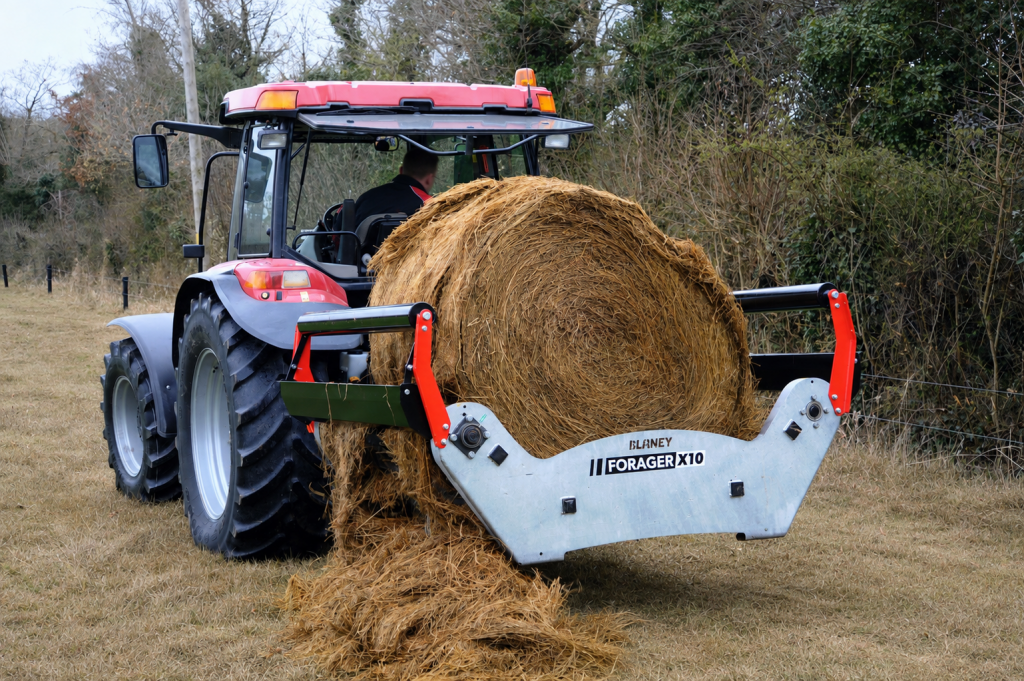
The Blaney Forager X10 is our premium round-bale feeding solution. It has been developed specifically to handle the wet, heavy, tightly packed, saggy and misshapen bales that can challenge conventional bale unrollers.
The X10 is Blaney’s best-selling bale feeder for a reason. It combines faster, easier loading with our most advanced bale-retention and feed-out technology, helping one operator complete the entire job with less interruption and considerably less physical handling.
Its working specification includes:
- Heavy-duty frame construction.
- Reinforced crossbars.
- Side rollers.
- Blaney’s specialist feed-out system.
- Advanced bale-retention technology.
- Hydraulic control of feed direction and discharge rate.
- An integrated self-loading system.
These features keep the bale securely contained and rotating as its weight, shape and consistency change.
The operator retains control from the beginning of the bale through to the final section. This produces a more consistent feed rate and reduces the sudden piles most likely to be trampled, contaminated, left uneaten or pushed through a feed barrier.
Faster and easier bale loading
The X10 incorporates its own bale-loading system, allowing one tractor and one operator to load, transport and feed without a separate loader or second tractor.
The time saving begins before feeding starts. The loading arrangement has been developed to make collecting and loading the bale quicker and easier, without repeatedly repositioning the tractor or relying on another loading machine.
On a job repeated every day throughout winter, those individual time savings soon become significant.
Once loaded, the operator can control the direction and rate of discharge from the tractor seat. The X10 can feed to either side, allowing the quantity placed in each paddock, passageway or feeding area to be adjusted.
The result is a genuine one-tractor feeding solution:
Load, carry and feed with one machine, one tractor and one operator.
It is this complete combination—not one isolated feature—that distinguishes the Forager X10 from a conventional bale unroller. Faster loading, positive bale retention, controlled discharge and the ability to handle difficult bales are incorporated into one Blaney feeding system.
A Forager X10 customer described the machine as “a game changer”, adding:
“It’s a super piece of equipment. It saves you a lot of time, effort and money.”
Bale Feeder X6: proven performance and outstanding value
For farmers working primarily with standard bales in favourable conditions, the Blaney Bale Feeder X6 provides a more economical alternative while retaining a substantial mechanical specification.
Economical does not mean stripped back.
The X6 offers proven Blaney engineering and self-loading operation in a compact machine designed to provide dependable performance over repeated feeding seasons.
It is approximately 1.85m wide and can operate in passageways of around 8ft, making it particularly useful in traditional farm buildings where access may restrict larger feeding machinery.
The X6 can feed from either side under hydraulic control. This allows the operator to regulate the feed-out rate and alternate the discharge direction when working in narrow passageways.
Its self-contained bale lifter turns loading and feeding into a one-tractor operation. The low cradle makes loading easier and improves access when removing plastic wrap or netting. Uneven-length loading tines mean only one tine needs to be aligned at a time when collecting the cradle.
Behind that straightforward operation is a working specification that includes:
- A chain rated at more than 50,000N.
- Hardened rollers to reduce friction and support smooth chain operation.
- Galvanised feed bars.
- A non-corrosive floor designed to encourage bale movement and rotation.
- Hydraulic control of feed direction and discharge rate.
- A frame developed using finite element analysis for strength with controlled machine weight.
- Three linkage mounting positions to accommodate different tractor heights.
- Compatibility with tractors from 75hp, subject to specification and operating conditions.
More than one million bales have been fed worldwide using the proven X6 design.
That working record demonstrates that the X6 is not simply an entry-level alternative selected on price. It is an established Blaney design that has proved its durability and practicality through extensive real-world use.
Should you choose the Forager X10 or Bale Feeder X6?
The distinction between the two machines is deliberate.
Choose the Bale Feeder X6 if you need:
- Robust and straightforward everyday bale feeding.
- A compact machine for narrower buildings and passageways.
- Self-loading, one-tractor operation.
- Strong mechanical specifications at an accessible price.
- Proven performance with standard bales in favourable conditions.
Choose the Forager X10 if you need:
- Blaney’s fastest and easiest one-tractor feeding solution.
- Greater control over wet, heavy, saggy or misshapen bales.
- Advanced bale retention as the bale becomes soft or loses its shape.
- More consistent feed-out under demanding conditions.
- Heavy-duty construction for intensive daily use.
- Faster and easier loading with fewer interruptions.
This gives farmers a genuine choice within the Blaney range rather than forcing a compromise.
The X6 provides proven performance and exceptional value for standard feeding conditions. The Forager X10 offers Blaney’s highest level of loading efficiency, bale control and difficult-bale capability.
One machine for outdoor feeding and winter housing
The current grass shortage has brought supplementary feeding forward, but the machinery requirement will not end when grass growth recovers.
A Blaney bale feeder can support outdoor buffer feeding now, before moving indoors with the cattle for the winter housing period.
The same machine can be used to:
- Feed along passageways and feed barriers.
- Distribute forage in yards and outdoor feeding areas.
- Supply out-wintered livestock.
- Divide individual bales between different groups.
- Reduce additional loader and tractor movements.
- Limit the manual work involved in pulling silage apart.
Choosing a Blaney machine means investing in a feeder developed for the complete working year—not purchasing a short-term response to the present shortage.
The same engineering that helps protect valuable forage outdoors can continue saving tractor movements, operator time and manual handling throughout winter.
Built on 30 years of agricultural engineering
Blaney Agri has spent 30 years developing agricultural machinery around the practical challenges encountered on working farms.
Rather than adapting a generic machine to perform the job, we have continually refined our feeding equipment around the difficulties farmers experience in practice: awkward loading, changing bale shape, inconsistent rotation, demanding materials and the need for one operator to work efficiently without unnecessary manual intervention.
Our wider feeding and bedding range includes bale shredders and cubicle bedders alongside the Forager X10 and Bale Feeder X6.
Every machine is developed with the same objective: to reduce unnecessary handling, improve control over material distribution and help one operator complete repetitive work more efficiently.
It is this combination of practical experience, proven designs and continued engineering development that separates Blaney machines from more basic alternatives.
Find the right Blaney feeding solution for your farm
If grass is running short or you are preparing for the winter housing period, speak directly to the Blaney Agri team.
We can help you:
- Compare the Forager X10 and Bale Feeder X6.
- Identify the right machine for your bale condition, tractor and farm layout.
- Discuss bale-shredding and cubicle-bedding requirements.
- Check availability of new and used machinery.
- Secure the best available deal for your requirements.
Call or WhatsApp: 0044 7436 284168 or contact us here.